
The Jacobites: The Real Story Behind Bonnie Prince Charlie, Culloden & Scotland's Last Rising
The real story of the Jacobite rising, from the standard raised at Glenfinnan to the slaughter at Culloden. Who was right, who was wrong, what was lost, and where to follow the trail today.
SCOTTISH HISTORYCULLODENJACOBITES
The Jacobites: The Real Story Behind Bonnie Prince Charlie, Culloden & Scotland's Last Rising
Not the romanticised version of tartans and Highland charges and a handsome prince with nothing to lose. The real version, complicated, human, often heartbreaking, and carrying consequences that shaped Scotland in ways we are still living with today.
DATE - 22 MAY 2026
12 MIN READ
HISTORY
•
•
◆ HISTORY
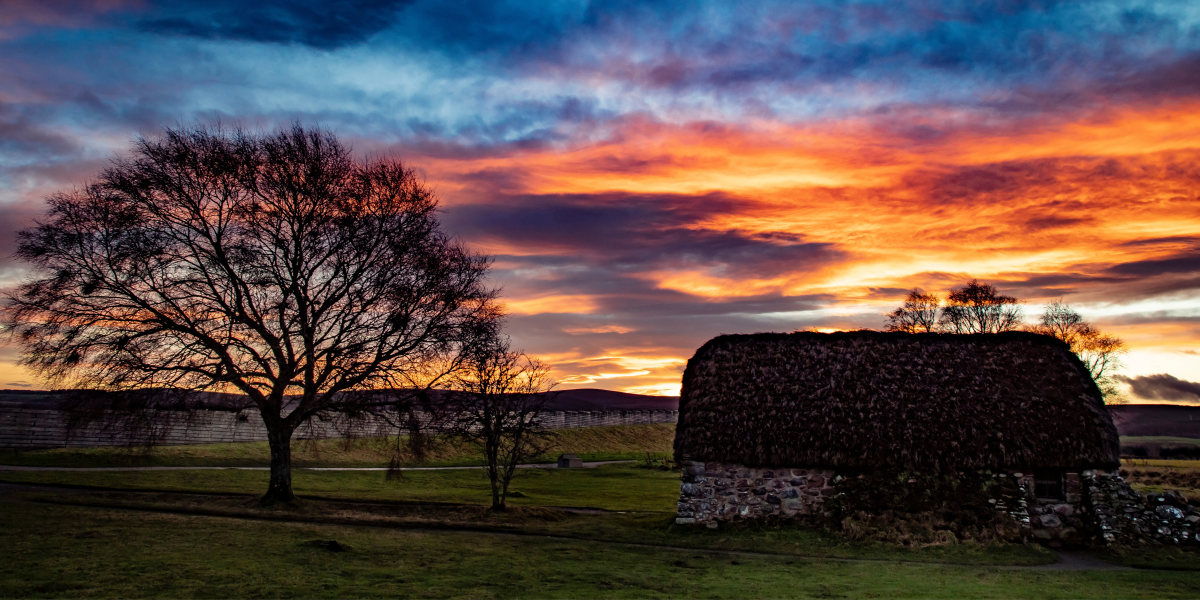
Leanach Cottage, Culloden
There are events in history that define a nation, not just because of what happened, but because of what was lost.
For Scotland, that event is Culloden. On a grey April morning in 1746, on a windswept moor a few miles east of Inverness, the last pitched battle ever fought on British soil lasted less than an hour. When it ended, over 1,500 Highlanders were dead or dying on the field. A way of life that had endured for centuries was about to be systematically, deliberately, and comprehensively destroyed.
I have stood on Culloden Moor more times than I can count. I have watched the silence fall across visitors who arrived knowing the history and were still not prepared for what it feels like to stand there. There is something in that landscape in the flatness of it, the exposure of it, the absolute ordinariness of a moorland that witnessed something so devastating that no amount of preparation quite equips you for.
"This is the real version, complicated, human, often heartbreaking, and carrying consequences that shaped Scotland in ways we are still living with today."
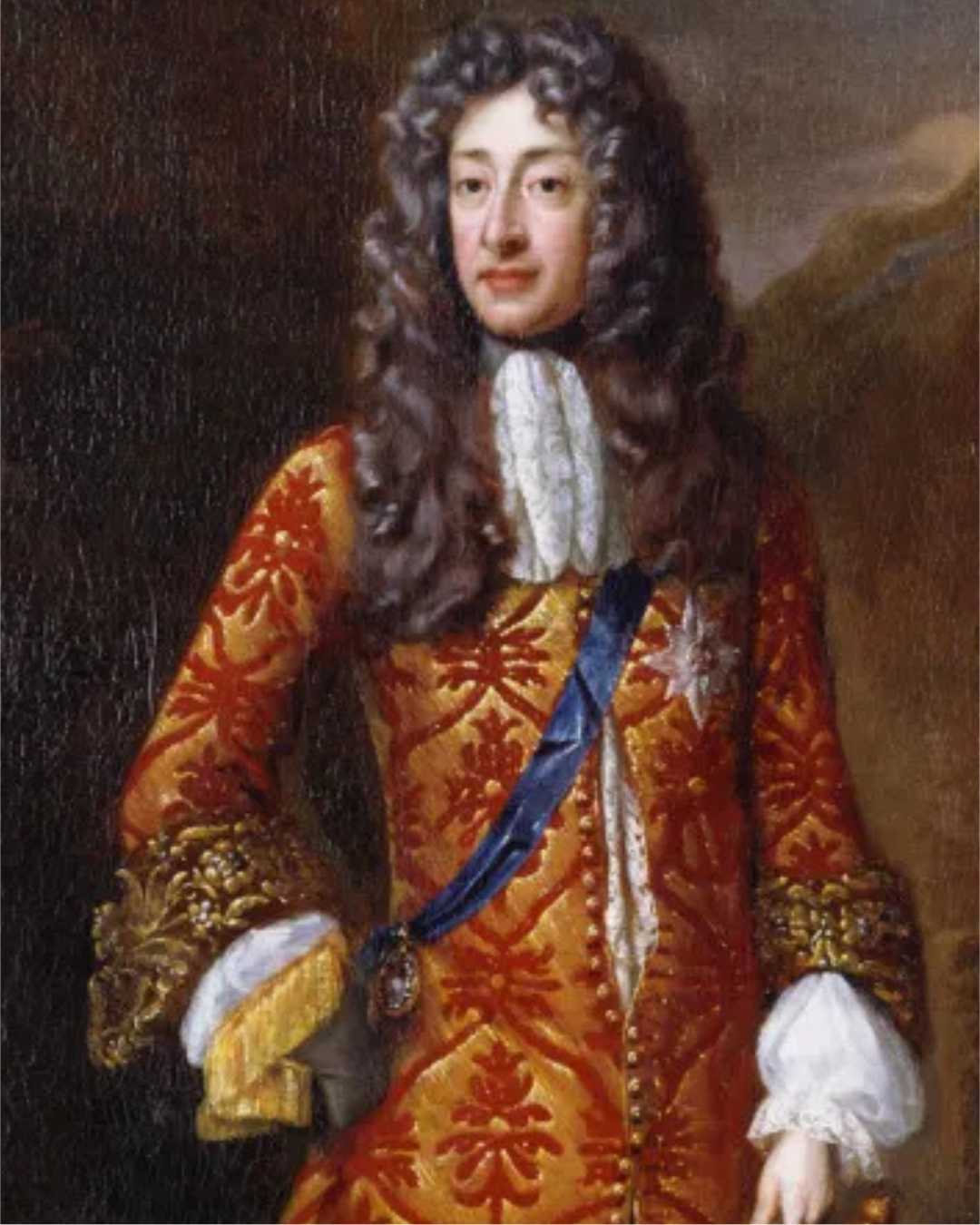
James VII of Scotland (James II of England)
To understand the Jacobites, you need to go back to 1685 and the death of King Charles II. He was succeeded by his brother James II of England (James VII of Scotland), a Catholic king in a fiercely, uncompromisingly Protestant country. James's attempts to relax anti-Catholic laws generated exactly the backlash he feared. In 1688, Parliament invited James's Protestant daughter Mary and her husband William of Orange to take the throne, an event that became known, with considerable optimism, as the Glorious Revolution.
James fled to France. With him went the Stuart cause. He and his descendants became known as Jacobites from Jacobus, the Latin for James, and from France, they would spend the next sixty years attempting to reclaim what they had lost.
The Jacobite cause was never purely about religion. It was also about Scottish sovereignty, deep resentment of English political dominance, economic grievances that had festered since the Act of Union in 1707, and, particularly in the Highlands, fierce clan loyalty to a dynasty the Gaelic world regarded as its legitimate rulers. These overlapping motivations made the Jacobite coalition simultaneously powerful and unstable. Everyone was fighting for the same cause. Almost nobody was fighting for exactly the same reason.
Why Did the Jacobites Exist?
• the jacobite risings
Five Risings: The Long Campaign
Each rising brought the Stuarts closer to and ultimately further from the throne they had lost.
The Fifteen in particular squandered an extraordinary opportunity. The Earl of Mar had every advantage. He squandered all of them.
And then 1745: the last rising, the one that came closest to success, and ended most catastrophically of all.
1689 - the first rising
1708 - the attempt
1715 - the fifteen
1719 - the nineteen
1745 - the forty-five
Victory at Killiecrankie; collapsed after Dundee killed
French fleet turned back; never landed.
Largest rising; squandered by the Earl of Mar
Spanish support; ended at Battle of Glen Shiel
Closest to success; ended at Culloden
The People at the Heart of It
Handsome, personally courageous, and possessed of a charm that could convince Highland chiefs to stake their lives on a cause most privately considered hopeless.
He arrived in Scotland in July 1745 with seven men, almost no money, and promises of French support that never fully materialised. The fact that he raised an army at all was remarkable. But Charles was also strategically impulsive in ways that cost the rising dearly, repeatedly wrong on the major decisions, and in the final months, prone to prioritising his own survival over the welfare of the men who had followed him.
He died in Rome in 1788, an embittered and largely broken man who had spent four decades in exile. He never returned to Scotland. The romantic image endures. The reality was considerably more complicated.
Prince Charles Edward Stuart - Bonnie Prince Charlie
• 1720–1788 - Born Rome, Died Rome
Lord George Murray - The Man Who Was Right
• 1694–1760 - The Man History Forgot
Lord George Murray is the figure the history books have treated most unjustly.
Murray was the finest military mind in the Jacobite camp; his tactics were brilliant throughout the campaign. He opposed the retreat from Derby. He argued strenuously against fighting at Culloden on the ground the government had chosen. On virtually every major strategic question, Murray was right, and Charles was wrong.
He fled to France after Culloden and died in exile in 1760, largely unrecognised. The Jacobite rising failed for many reasons. One of them was that its best general wasn't listened to.
The Duke of Cumberland - William Augustas
• 1721–1765 - COMMANDER AT CULLODEN
The son of King George II, Cumberland, commanded the government forces at Culloden with methodical professionalism.
He was twenty-four years old. His army was better trained, better fed, better equipped, and better rested than anything the Jacobites could field by April 1746. His victory was decisive and entirely deserved on military grounds. The brutal repression that followed the execution of wounded prisoners, the burning of homes, and the systematic destruction of Highland culture earned him the nickname the Butcher.
He was briefly celebrated as a hero in England. His legacy in Scotland was and remains one of infamy.
Flora MacDonald - The Woman Who Saved the Prince
• 1722–1790 - buried at kilmuir, isle of skye
Flora MacDonald was twenty-four years old when she made the decision that would define the rest of her life.
In June 1746, with the prince a fugitive hunted across the Highlands with a £30,000 reward on his head, Flora helped disguise Charles Edward Stuart as her Irish spinning maid, Betty Burke and sailed him through government-patrolled waters from South Uist to Skye. She knew exactly what she was risking. She was arrested shortly afterwards but eventually released and returned to Skye. She is buried at Kilmuir Cemetery on Skye, overlooking the sea.
Visitors come from across the world to stand at her grave. Her courage is immortalised in the Skye Boat Song, written in 1884, nearly one hundred and forty years after the events it describes. It has not diminished in the telling.
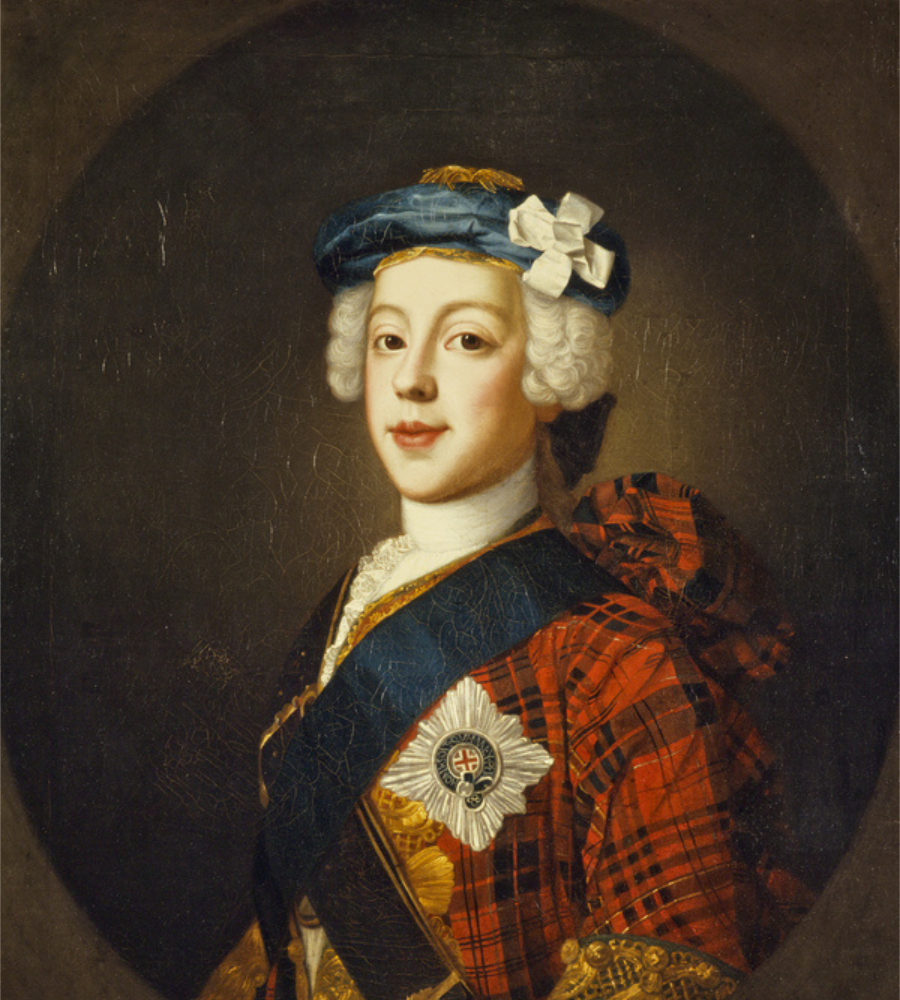
Bonnie Prince Charlie
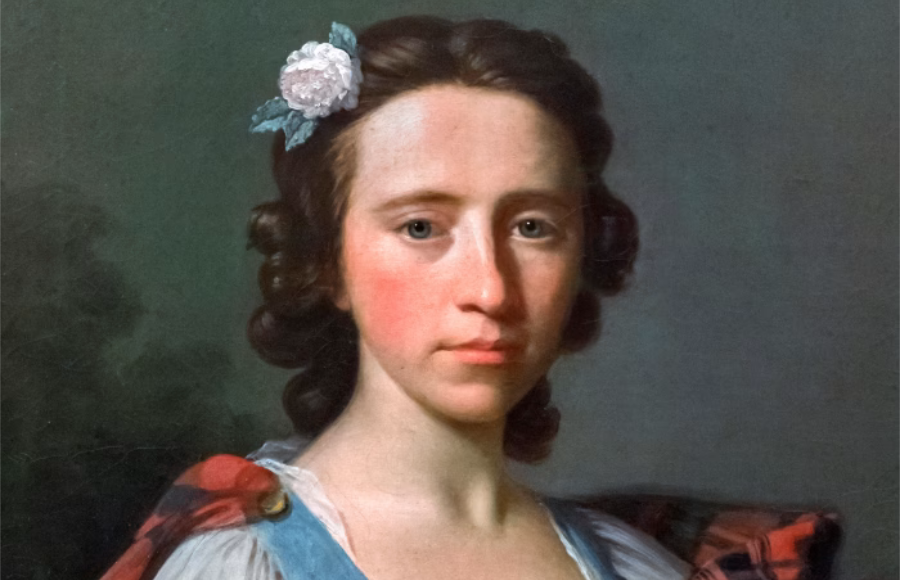
Flora MacDonald
Nine Months That Almost Changed History
Charles first set foot on Scottish soil on the 23rd of July 1745, landing on the Hebridean island of Eriskay with seven companions.
On the 19th of August 1745, the Jacobite standard was raised at Glenfinnan, at the head of Loch Shiel. Cameron of Lochiel arrived with 700 men. MacDonalds came. More followed.
Stand there on a clear day with the loch stretching away behind you and the mountains rising on both sides, and you begin to understand why men who knew the odds came anyway.
• THE STANDARD RAISED AT GLENFINNAN - AUGUST 1745
• VICTORY AT PRESTONPANS - SEPTEMBER 1745
The Jacobite army swept south and took Edinburgh without a fight, holding court at Holyroodhouse in a brief, glittering blaze of Stuart glory.
On the 21st of September 1745, at Prestonpans east of Edinburgh, Lord George Murray's strategy produced one of the most stunning victories in Scottish military history. The Jacobite charge surprised the government forces at dawn. In roughly ten minutes, the battle was over. The government commander, Sir John Cope, fled the field so quickly that the incident became the subject of a satirical song Hey, Johnnie Cope, are ye waukin' yet? that Scots still sing with considerable pleasure.
• THE MARCH TO DERBY - NOVEMBER-DECEMBER 1745
The Jacobite army crossed the English border on the 8th of November. They reached Derby on the 4th of December, 127 miles from London. The capital was in near-panic. King George II was said to have packed his bags. The Bank of England paid out in shillings to slow a run on its reserves.
Then came the 5th of December. Black Friday in the Jacobite story. The council of war voted to retreat. Charles argued furiously for pressing on to London. He was overruled. In hindsight, the retreat was almost certainly the correct military decision. But it broke the momentum that had made the whole extraordinary advance possible, and it broke something in Charles Edward Stuart that never fully recovered.
• THE ROAD TO CULLODEN - JANUARY-APRIL 1746
The retreat north was orderly but demoralising. By February, the army had retreated to Inverness. For two months, they sat and waited while Cumberland methodically advanced northward, his men well-fed and professionally trained. By April, the Jacobite army was in serious difficulty, men surviving on rations of three biscuits a day.
On the night of the 15th of April, Murray proposed a night march to surprise Cumberland's camp at Nairn. The march began in darkness. It was disorganised and agonisingly slow. Dawn came before they reached Nairn. They turned back, exhausted, hungry, and demoralised. Hours later, they would fight the Battle of Culloden.
The Battle - 16 April 1746
Lord George Murray had argued strenuously against fighting on Drummossie Moor. The ground was flat and open, ideal for Cumberland's artillery and cavalry, catastrophic for the Highland charge that was the Jacobite army's primary and essentially only tactic. Murray had identified better ground nearby. Charles overruled him.
The government artillery opened fire at around one in the afternoon. For over twenty minutes, cannon shot tore through the Jacobite lines as men stood unable to advance, waiting for an order that was inexplicably, fatally delayed. When the charge finally came, it was ragged and uncoordinated. The government infantry met them with disciplined musket fire and a new bayonet technique specifically designed to defeat the Highland charge, each soldier directing his bayonet not at the man directly in front of him, but at the unshielded side of the man to his right.
• the BATTLE OF CULLODEN - 16 APRIL 1746
DURATION:
jacobite dead:
government dead:
Jacobite rations that day:
last battle fought on british soil:
Less than one hour.
~1500 on field and in persuit
52
Three biscuits per man
Still true 280 years later.
It was not a battle in any conventional sense. It was a slaughter of exhausted, starving men on ground their commanders had begged not to fight on, against an enemy that had spent two months preparing for exactly this moment.
The Aftermath: How Culloden Changed Scotland Forever
Wounded Jacobites were bayoneted where they lay. Fleeing soldiers were hunted down and executed. Government troops swept through the Highlands, burning settlements, seizing livestock, and killing suspects with a ruthlessness that went far beyond any military necessity. Cumberland earned the nickname the Butcher. It was not undeserved.
• THE repression
• THE destruction of a culture
Parliament acted swiftly to ensure there would never be another rising. The Disarming Act stripped the Highlands of weapons. The Heritable Jurisdictions Act dismantled the clan system entirely. Most devastating of all, the Act of Proscription banned the wearing of Highland dress tartan, the kilt, and the plaid under pain of transportation. Bagpipes were classified as instruments of war and outlawed. The Gaelic language was suppressed in schools and public life.
The traditional social structure of the Highlands was gone. Clan chiefs became landlords. Their people became tenants with no security and no rights. The cultural and economic conditions for the Highland Clearances, which would empty the glens of their people in the following decades, were now firmly in place. Culloden did not just end the Jacobite rising. It ended an entire way of life.
• THE escape and the long exile
Charles Edward Stuart spent five months as a fugitive in the Highlands and Islands, hunted by government forces with a £30,000 reward on his head. Despite the poverty of those who sheltered him and the impossible scale of the reward, not one person betrayed him.
Not one person betrayed him. A £30,000 reward, a sum almost beyond comprehension for most people in 18th-century Scotland, and not one person took it. That fact is one of the most remarkable demonstrations of loyalty in the whole of Scottish history.
⚜️
remember this
Charles finally reached France in September 1746. He never came back to Scotland. He died in Rome in 1788, four decades of exile and increasing bitterness behind him, having outlived the cause, the hope, and most of the people who had believed in him.
Separating the Myth From the Reality
• Myth
"Culloden was Scotland versus England"
It was not. There were more Scots fighting for the government at Culloden than for the Jacobites. Three Scottish regiments of the British Army fought against Charles. Lowland Scotland was largely indifferent or actively hostile to the rising. This was a civil war as much as a national conflict.
• Myth
He was courageous and genuinely inspiring in the early months. He was also strategically impulsive, frequently wrong, and ultimately self-serving when things fell apart. Lord George Murray, who was right about almost everything, has been largely forgotten. History is not always just.
• Myth
Highland dress predates the Jacobites, certainly. But the clan-specific tartanry associated with Scotland today was largely an invention of the 19th century, driven partly by the romanticisation of a Jacobite cause that was safely over and could now be celebrated without political risk. King George IV's visit in 1822, choreographed by Walter Scott, was where much of it was consolidated. Scotland has been performing its own mythology ever since, with considerable enthusiasm and no apparent self-consciousness.
"Tartan and Highland dress are ancient, unbroken traditions"
"Bonnie Prince Charlie was a heroic, selfless leader"
"The Jacobites were fighting for Scottish independence"
• Myth
They were not. The Jacobite cause was principally about restoring the House of Stuart to the British throne, a throne that included England. It was a dynastic cause, not a nationalist one, and many of its leaders were as committed to their English claims as their Scottish ones.
Where to Follow the Jacobite Trail
Where the standard was raised in August 1745. The tall tower stands at the head of the loch in one of the most dramatic settings in Scotland. Free to visit the monument itself. Stand there on a clear day, and you begin to understand why men who knew the odds came anyway.
Glenfinnan Monument
• National trust for scotland - glen shiel
Palace of Holyroodhouse
• edinburgh - royal mile
Where Charles held his brief, glittering court following the capture of Edinburgh. The historic apartments include the chambers where the Stuart court was momentarily re-established. The palace's Jacobite connection is real and tangible. This is where the whole extraordinary gamble briefly, dazzlingly, looked like it might succeed.
Prestonpans Battlefield
• east lothian - visitor experience opened 2023
The site of the Jacobites' greatest victory, with a visitor experience that opened in 2023 and does justice to a battle that lasted ten minutes and changed the course of the rising. Significantly undervisited relative to its historical importance.
Culloden Battlefield
• national trust for scotland - near inverness
The essential Jacobite pilgrimage. An outstanding visitor centre, a walking trail through the graves, and a Battle Immersion Experience. One of the most moving places in Scotland. Open year-round. Go on a quiet day if you can. Go in April if you are able. The moor in April has a particular quality that is unlike any other month.
• outer hebrides - south uist
Eriskay
The island where Charles first stepped on Scottish soil on the 23rd of July 1745, wading ashore onto a beach that has barely changed since. Remote, atmospheric, and carrying a weight of historical significance entirely disproportionate to its size.
Flora MacDonald's Grave, Kilmuir
• isle of skye - clifftop cemetery
A clifftop cemetery overlooking the sea where the woman who saved the prince is buried. Visitors come from across the world. It is exactly as moving as you'd expect, and then a little more.
Why the Jacobites Still Matter
The Jacobite rising of 1745 lasted nine months. In that time, it came closer to overthrowing the British state than any domestic movement before or since. It ended in catastrophe for the cause, for the clans, and for a Highland way of life that never recovered.
What it left behind was something more durable than any throne could have been: a mythology. The romantic exile. The loyal Highlander. The brave woman who risked everything for a man she barely knew and a cause she understood clearly enough to know was likely doomed. These images have entered the global imagination in a way that no successful rising could possibly have achieved.
Scotland has been telling this story for nearly three centuries in songs, in poems, in novels, in television series, because it contains something that never grows old. Loyalty. Loss. The question of what it means to fight for something you know you are probably going to lose.
"Stand on Culloden Moor on a grey April morning and you will understand why it still matters. The silence is not empty. It is full of everything that happened there, and everything that came after. Come and stand there. Come and feel it. The moor has been waiting."
Share this post
TOPICS:
Lesley Kennedy
Host & Creator
Lesley is a born-and-bred Scot, tour guide, and amateur photographer who has been helping visitors fall hopelessly in love with this country for years, and she's not sorry about it.
Love Scotland as much as we do? Come and join the conversation on the Everything Scotland Podcast episodes out now.
📸 Follow along on Facebook & Instagram for Scottish history, landscapes, and stories from the road.
ABOUT THE AUTHOR
© 2026 Everything Scotland
POPULAR
A podcast, blog, and travel guide for everyone who loves Scotland, its history, landscapes, food, language, culture, and people.
EXPLORE
ABOUT
Privacy Cookies