
What Is a Ceilidh? Scotland's Most Joyful Tradition Explained
KAY-lee. Now you know. Scotland's most joyful tradition explained, from school gym halls to wedding dancefloors, here's everything you need to know about ceilidhs.
TRADITIONCULTURETHINGS TO DO
What Is a Ceilidh? Scotland's Most Joyful Tradition Explained
It's KAY-lee. Live fiddles, partner dancing, a caller shouting instructions over the music, and absolutely nobody caring who gets the steps wrong. Here's everything you need to know before you go.
DATE - 25 MAY 2026
11 MIN READ
CULTURE
•
•
◆ CULTURE
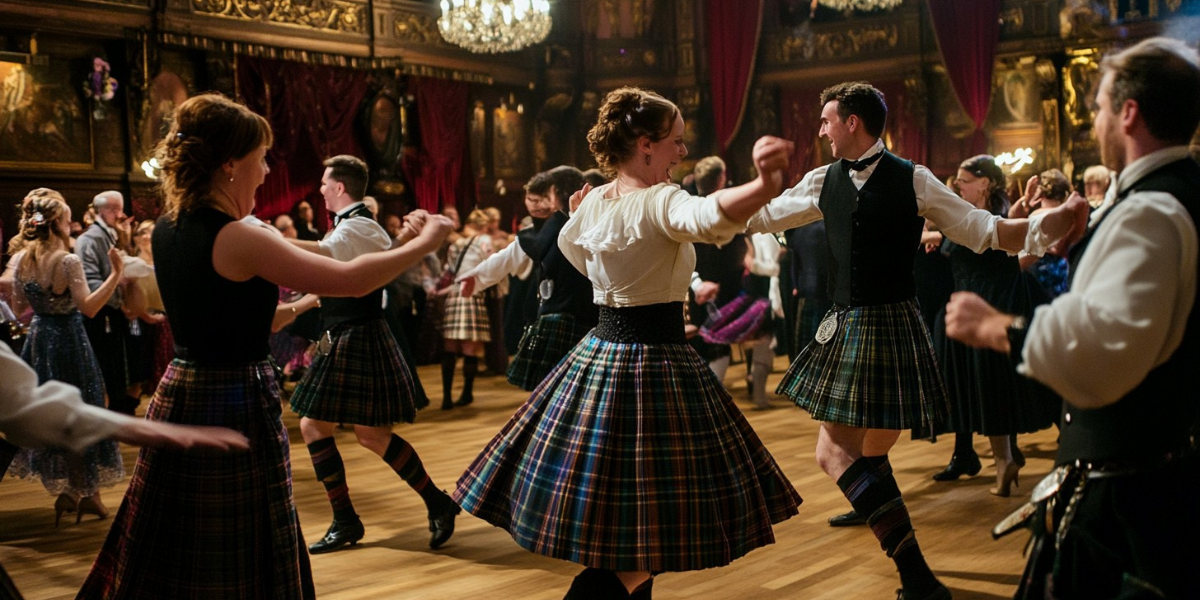
Participants having fun at a Ceilidh
Before we go any further, let's deal with the pronunciation.
It's KAY-lee. Not SEE-lid. Not CHEE-lid. Not SIGH-lith or any of the other brave attempts I've witnessed over the years. KAY-lee. Say it out loud right now, and you are already ahead of most first-timers, and you have already made every Scottish person in the room like you slightly more.
Right. Now we can begin.
Picture a room full of people who mostly don't know each other. A live band in the corner is playing fiddles and accordion at a pace that makes standing still feel like a physical impossibility. Someone in the middle of the floor is shouting instructions that you can just about hear over the music. Everyone laughing. Everyone spinning. At least two people facing completely the wrong direction. At least one person on the floor who wasn't planning to be.
"A ceilidh is the most joyful thing Scotland has ever produced. Which is saying something, because Scotland has produced some very fine things."
And nobody, not a single person in that room, is caring even slightly. That is a ceilidh.
The word ceilidh comes from the Scottish Gaelic for gathering, or visit. In its original form, and this surprises people, a ceilidh wasn't primarily about dancing at all. In the Gaelic communities of the Highlands and Islands, a ceilidh was any communal gathering: storytelling, song, music, conversation, the passing on of oral tradition. People would come together in a neighbour's home after dark, share news, play instruments, and sing. Winter nights in the Highlands were long and dark and cold, and the need for warmth and company was a serious, practical matter.
The dancing came later, as the natural extension of the music. By the 18th century, it was firmly embedded in Highland and Lowland Scottish social life as a central feature of weddings, harvest festivals, and seasonal celebrations. It was also, for generations, where young people met prospective partners. The combination of physical proximity, shared exertion, and the inevitable hilarity of group dancing made the ceilidh Scotland's primary social mixer for centuries. It remains astonishingly good at this today.
Today, a ceilidh means one thing above everything else: an evening of live Scottish folk music and traditional partner dances, conducted with absolute chaos and complete inclusivity. You don't need to know the steps. You don't need a partner. You don't need to be Scottish, young, particularly fit, or entirely sober. You need comfortable shoes, the willingness to look ridiculous, and the understanding that getting it wrong is, in ceilidh culture, getting it exactly right.
What the Word Actually Means
A History Worth Knowing
After the Battle of Culloden in 1746, the British government moved swiftly to destroy Highland culture. Highland dress was banned. Bagpipes were outlawed as instruments of war. The Gaelic language was suppressed. And ceilidhs, those communal gatherings that had kept communities together through centuries of hardship, went underground. Held secretly in remote glens and farmhouses, passed between communities whose very survival depended on holding onto what was theirs, the ceilidh became an act of cultural resistance as much as a social pleasure.
The tradition survived. The bans did not. This is, when you think about it, one of the more satisfying outcomes in Scottish history.
Robert Burns, Scotland's national poet, was a passionate participant in ceilidh culture, and many of his most celebrated songs were inspired by the music, stories, and warmth of these gatherings. Burns Night, celebrated on the 25th of January every year, almost always includes a ceilidh. It would feel incomplete without one.
In recent years, the ceilidh has undergone something of a renaissance, driven by a wider revival of interest in Scottish folk culture and by the discovery, made afresh by each new generation, that nothing breaks down social barriers quite as efficiently as being flung around a dance floor by a stranger while a fiddle plays faster than seems reasonable.
Social Dance: Scotland's Greatest Involuntary Education
Before we go any further, we need to talk about Social Dance.
Every Scottish person of a certain age, and by certain age, I mean anyone who attended a Scottish school at any point in the last several decades, will recognise these two words with a specific, visceral, full-body response. Not quite dread. Not quite excitement. Something in between that has no proper name but is immediately, universally understood by anyone who has been through it.
Social Dance is the annual tradition by which Scottish schoolchildren, in the weeks running up to Christmas, are marched into the assembly hall or the gym and taught ceilidh dancing. Whether they want to or not. Which they do not.
The format is almost identical in every school in Scotland, across every generation, as if there is a national blueprint locked in a vault somewhere. The PE teacher, or occasionally a brave music teacher who has drawn the short straw, attempts to explain the Gay Gordons to forty children who are radiating hostility in equal measure. You are paired with a partner. Not a partner you have chosen. A partner you have been assigned. Someone you either have a complicated social history with, have an excruciating crush on, or have never spoken to in your life, and would very much like to keep it that way.
The music starts. You have to hold hands. You spin. Someone goes the wrong way. Someone always goes the wrong way. The teacher shouts instructions over the music that nobody can hear. The boy who didn't want to be there clumsily whacks his partner in the face during Strip the Willow. The girl who takes it seriously carries the entire set with the grim determination of someone who has decided that if she is going to be humiliated, she is at least going to do it correctly. There is giggling. There is stumbling. There is at least one collision significant enough to produce a genuine apology.
It is, by any objective measure, horrible. Embarrassing. An assault on the dignity of everyone involved. The complaints on the way home are extensive and heartfelt.
And yet.
Ask any Scottish adult about their school Social Dance, and watch what happens to their face. The exasperation softens. A smile appears that they are slightly surprised by. And then they start telling you about it, about the specific chaos of their particular assembly hall, about who they were paired with, about the one dance they actually got right, about the teacher's increasingly desperate instructions, about the moment it stopped being mortifying and became, against all expectation, a tiny bit fun.
Because here is what Social Dance actually is, beneath the embarrassment and the unwilling participation and the hands that nobody wanted to hold: it is Scotland quietly passing something on.
Before you were old enough to choose it, before you had any opinion about Scottish culture, ceilidh dancing, or traditional music, Scotland handed you the steps. Made you learn them in your school uniform, in the gym that smelled of whatever gym halls smell of, with partners you didn't choose, to music played on a slightly tinny speaker. It gave you the muscle memory and the humiliation in roughly equal measure, knowing, as teachers and parents and the whole country knew, that one day you would be at a wedding or a Hogmanay party or a corporate ceilidh night, and the music would start, and you would know what to do.
That knowledge is a gift. You just didn't appreciate it at the time.
The Music
The music is what makes a ceilidh, and a great ceilidh band is not accompaniment; it is the engine of the entire evening. Setting the pace, building the energy, knowing exactly when to push the tempo and when to let the dancers breathe.
The core ceilidh sound is built on the fiddle, the most expressive instrument in Scottish folk music, accompanied by piano or accordion for harmonic foundation and often by drums, guitar, or bass for propulsion. The tunes are drawn from centuries of Scottish folk music: reels, fast and driving; jigs, bouncing and rhythmic; strathspeys, a distinctly Scottish slow-stepping form found nowhere else in the world; and waltzes for the gentler dances.
Every ceilidh has a caller, someone who explains each dance before the band starts and calls out instructions during the dance itself. Pay attention. They are the only thing standing between you and complete chaos. The chaos still happens. It's better with a caller.
🎤
A WORD ABOUT THE CALLER
Most ceilidhs feature a rotating programme of six to twelve dances over the course of an evening. Here are the ones you are most likely to encounter, and what you need to know.
• Almost Always First — The Icebreaker
Couples progress around the room in a large circle, alternating a march with a quick spin. The name refers to the Gordon Highlanders regiment and nothing else. This comes up every time and is best addressed immediately. The steps are simple enough to learn in one pass from the caller, and the circular format means you can't easily get separated from your partner. Hold on firmly. The spin is faster than it looks.
The Dances: A Survival Guide
The Gay Gordons
Dancers form groups of three facing another group of three, performing a sequence of moves before moving on to the next group. Within fifteen minutes, you will have danced with everyone in the room. Within thirty, you will be completely out of breath and will not care in the slightest. Don't panic when you lose track of where you are. You'll be swept along anyway. This is part of the design.
The Dashing White Sergeant
• Scales Beautifully — 10 to 500 People
Couples form two long lines. The top couple works down the line, swinging each other in the middle before spinning with each person in turn. By the time you reach the bottom, you have been flung around by every single person in the set. It is fast. It is physical. It is absolutely not to be attempted in heels. Flat shoes. Proper grip. Genuine commitment. This is not the dance to hold back in.
Strip The Willow
• Separates the Tentative from the Committed
A long, formal reel for eight dancers that includes an extended solo section where each dancer takes a turn in the centre of the circle. The solo can be as simple or as elaborate as confidence allows. Most people opt for a modest jig and a hopeful expression. Some go full Highland fling. Both are completely acceptable. The audience cheers for all of them. You will absolutely lose track of where you are in the sequence. So will everyone else. Keep moving. This is the correct approach.
The Eightsome Reel
• The centrepiece
A progressive partner dance where couples move around the room to a waltz-like rhythm before switching to a quick polka section. The tempo change catches people out every time. The Canadian Barn Dance was brought back to Scotland by emigrants and reintroduced as part of the 20th-century folk revival, giving it a transatlantic history that nicely mirrors Scotland's own diaspora story. There is something pleasing about a dance that crossed an ocean and came home.
The Canadian Barn Dance
• A Transatlantic History
A couple dance in closed hold through a simple sequence of forward steps, turns, and chassées in waltz time. It is the dance that grandparents lead confidently and apparently effortlessly while everyone else watches and wonders how they make it look so easy. Relax. Let the music do the work. This is the recovery dance, and it is a wonderful thing to have in the programme.
The St Bernard's Waltz
• The Recovery Dance
What to Expect at Your First Ceilidh
First-timers often arrive with a mixture of excitement and low-level terror. Here is what actually happens.
A typical ceilidh evening runs for three to four hours. The band plays a set of six to eight dances, takes a break, the bar does excellent business during this period, and returns for a second set. Most dances last between five and fifteen minutes. The evening almost always ends with Auld Lang Syne, at whatever pace the band decides is appropriate for the current state of the room.
Most ceilidh dances involve partner rotation; you will dance with many different people over the course of the evening. This is intentional. It is part of what makes the ceilidh such an extraordinarily effective social mixer. At Scottish weddings, it is entirely normal to find yourself being enthusiastically swung around by the bride's grandmother within twenty minutes of arriving. This is not an accident. It is the point.
You will make mistakes. Everyone does. The experienced dancers will gently redirect you without breaking stride. The band will continue regardless. The caller will shout something encouraging. No one will care, because everyone is making the same mistakes. The measure of a ceilidh is not technical precision, it is collective joy, and joy is remarkably forgiving of two left feet.
🤝
THE UNWRITTEN RULE
If someone extends their hand to you, you take it. You join the dance. You do your best. It has worked perfectly for several hundred years and will work for you, too.
Where to Find a Ceilidh in Scotland
Ceilidhs happen year-round across Scotland, from major city venues to village halls in the Outer Hebrides.
• Edinburgh — Summerhall (Tue) & Assembly Roxy (monthly Fri)
Edinburgh Ceilidh Club
Scotland's most accessible regular ceilidh for first-timers and experienced dancers alike. Running since 2005, with a caller at every event and complete beginners genuinely welcome. Adults from £9. Kids go free on Tuesdays. If you are in Edinburgh and want your first ceilidh, start here.
• Glasgow Merchant City — Every Friday, 8.30pm–midnight
Ghillie Dhu - Burly Ceilidh Club
Regular ceilidh nights in a spectacular converted church with vaulted ceilings, chandeliers, and a room that makes the whole experience feel appropriately theatrical. Join from 9.30pm for ceilidh only, from £15 at the door. Dinner and ceilidh packages are also available. One of the most atmospheric ceilidh settings in Scotland.
• Edinburgh West End — Converted Church
Laldie Ceilidh
Monthly ceilidh events with some of Scotland's finest folk bands. High-energy nights with a devoted local following and a programme that takes the music seriously.
• Edinburgh — Assembly Roxy, Monthly
Glasgow's most beloved weekly ceilidh, with house band Chitterybite, in a magnificent Victorian bar with original fittings that has been part of the Merchant City's social life for generations. Tickets from £8. Book early; it sells out regularly, and with good reason.
Sloans Bar & Restaurant
• Edinburgh — St James Quarter, Last Thursday Monthly
Free with pre-registration, in a beautiful setting in the heart of the city. Perfect for first-timers who want to try before committing to a ticketed event. No excuses.
White Heather Ceilidh Club
Where to Find a Ceilidh in Scotland
There is a reason the ceilidh has outlasted everything that Scottish history has thrown at it: the Clearances, industrialisation, the 20th century's relentless displacement of community life, and the smartphone.
It is fundamentally democratic. In a ceilidh, age, income, background, and dancing ability are completely irrelevant. The rotation of partners means you cannot stay in your comfort zone. The physical nature of the dance means you cannot remain a bystander. The shared laughter of collective failure means the barriers between strangers dissolve faster than in almost any other social setting.
For visitors, a ceilidh is the fastest route to the real Scotland. Not the Scotland of castles and whisky tastings and carefully composed photographs, all of which we love and will happily talk to you about at length. The Scotland that actually lives. Warm, funny, inclusive, slightly chaotic, and absolutely committed to a good time.
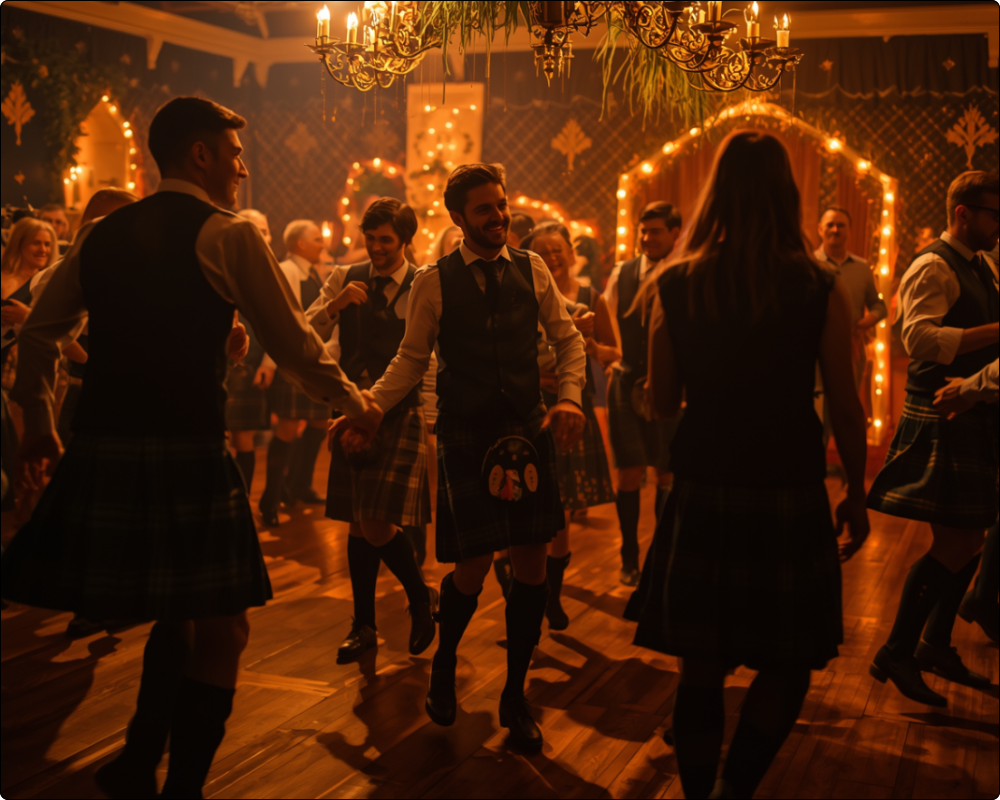
Ceilidh dancing at a wedding reception
Just Go
Every first-time ceilidh attendee arrives with some combination of curiosity and apprehension. Every single one of them leaves having had a brilliant time. The formula is almost embarrassingly simple: live music, inclusive partner dancing, a caller who makes it accessible, and Scotland's particular genius for collective warmth and it simply, reliably works.
You will get the steps wrong. You will be spun too fast and in the wrong direction. You will end up in the wrong set and have absolutely no idea which way to go. And you will be completely, entirely fine because so will everyone else, and the fiddles will still be playing, and the caller will still be shouting, and at the end of the evening you will have sore feet and flushed cheeks and the particular, irreplaceable satisfaction of a night that asked nothing of you except showing up and joining in.
"If you find yourself in Scotland and hear the distant sound of fiddles and stomping feet and laughter coming from somewhere nearby, follow it. You'll know what to do when you get there."
Share this post
TOPICS:
CEILIDH
FOLK MUSIC
TRADITION
THINGS TO DO
CULTURE

Lesley Kennedy
Host & Creator
Lesley is a born-and-bred Scot, tour guide, and amateur photographer who has been helping visitors fall hopelessly in love with this country for years, and she's not sorry about it.
Love Scotland as much as we do? Come and join the conversation on the Everything Scotland Podcast episodes out now.
📸 Follow along on Facebook & Instagram for Scottish history, landscapes, and stories from the road.
ABOUT THE AUTHOR
© 2026 Everything Scotland
POPULAR

A podcast, blog, and travel guide for everyone who loves Scotland, its history, landscapes, food, language, culture, and people.
EXPLORE
ABOUT
Privacy Cookies